Worth Doing Badly
Machines just made competence abundant, and everything we ship now arrives looking professional. Which means the most valuable thing left to do with our own hands may be the thing we do badly.
Competence just became a commodity. Ask a machine for a report and the report arrives structured, footnoted, and grammatical. Ask for code and the code compiles. The floor of polish, which every profession spent a century raising inch by inch, went up several storeys in a single renovation, and now nearly everything that crosses our desks looks finished.
We should be honest about what this abundance quietly devalues, and what it quietly crowns. It devalues polish, because polish is now the default texture of everything. And it crowns something we have spent our whole careers trying to eliminate: the experience of being bad at something.
That sounds perverse, so let us walk it slowly.
Where Taste Actually Comes From
Judgment is not downloaded. It is sedimented. The engineer who can glance at a design and feel that something is wrong acquired that feeling through years of designs that were wrong in her own hands. The editor who can cut a paragraph without hesitation once wrote a thousand paragraphs that deserved cutting. Every act of discernment we prize is the residue of time spent on the wrong side of good.
This was always true, but it used to be enforced automatically. There was no way to reach competence except through incompetence; the toll road was the only road. Now there is a bypass. The machine will hand any of us a professional-looking result before we have had time to be wrong even once. The draft arrives pre-polished, the deck pre-structured, the code pre-idiomatic.
The bypass is a genuine gift; only a romantic would refuse it for production work. But we should notice what the toll road was selling besides delay. It was selling calibration. A person who has never been bad at a thing cannot tell why a good version is good. They can verify that it works; they cannot feel where it is weak. And an organization full of people who can verify but not feel is an organization that will approve a thousand adequate things and never once recognize an excellent one.
So the question for this decade is not how fast we can reach polish. Polish is solved. The question is where the calibration will come from once nobody has to earn it.
The Most Misquoted Sentence in English
In 1910, in a book called What’s Wrong with the World, G.K. Chesterton wrote a sentence that has been misread ever since: “if a thing is worth doing, it is worth doing badly.”
Generations have quoted it as a shrug, permission for sloppiness. It is the opposite. Chesterton was writing about the activities so central to a human life that they must not be handed to specialists: writing one’s own love letters, blowing one’s own nose, raising one’s own children. His point was that for certain things, the doing is the value, and therefore an imperfect doing by the right person beats a flawless doing by proxy. A hired poet could write a technically superior love letter. It would also be worthless, because the labour of the letter was the love.
The old word for this arrangement is amateur, and we have let it curdle into an insult. It comes from the Latin amator: one who loves. The professional does the thing for the result; the amateur does the thing for the thing. For as long as results were scarce, the professional rightly ran the world. But we have just entered the first era in which results are cheap and the doing is scarce. It is a strange and rather wonderful inversion: the economy of the amateur, the person whose relationship with the work survives even when the output is no longer needed from them, has suddenly become the economy of taste.
A City of Cheerful Amateurs
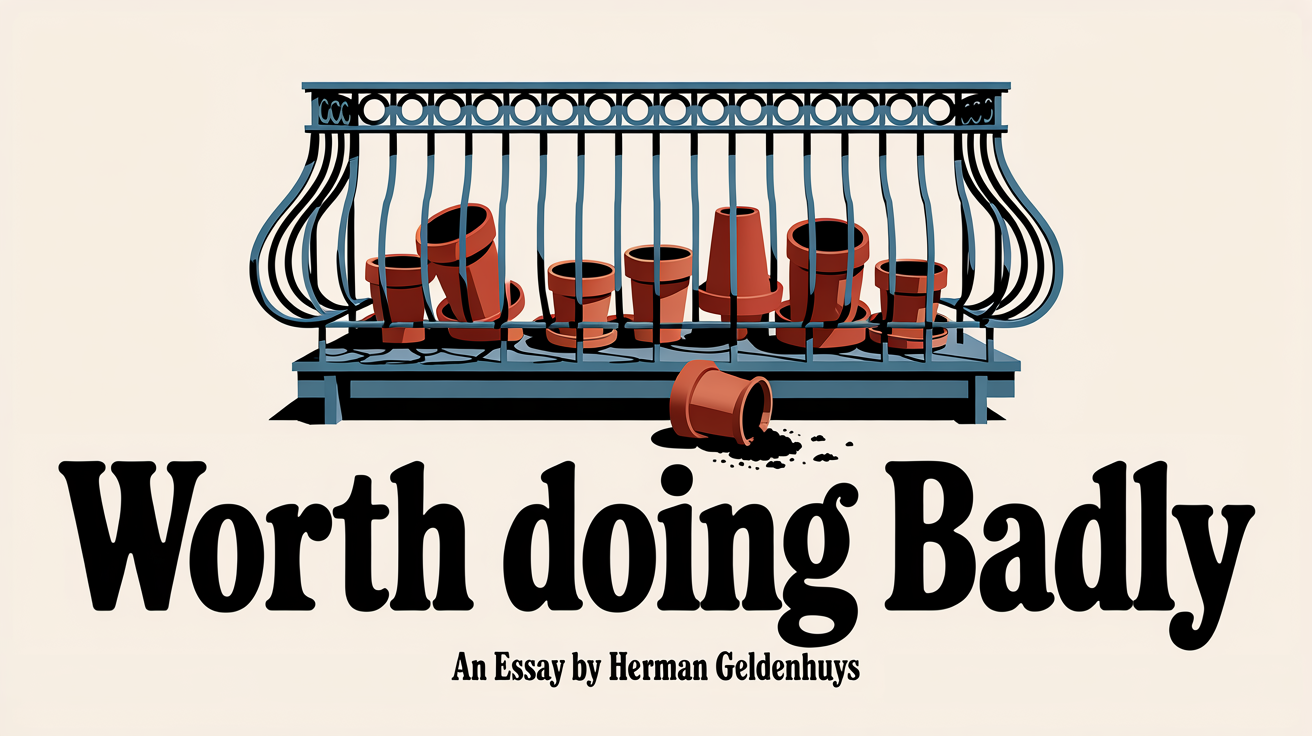
Montreal, it must be said, never fully surrendered to the cult of the polished result. This is a city of beer-league defencemen, of balcony gardens that lean, of festival stages that hand the microphone to whoever showed up. Above all it is a bilingual city, which means most of us spend part of every working day being publicly mediocre in our second language. We fumble a conjugation in a meeting, everyone waits, we get there. And we have all noticed the curious social physics of it: the fumbling builds more trust than fluency would. The willingness to be bad at something in front of colleagues is the fastest proof that the thing, and the colleagues, matter to us. We have been rehearsing the amateur economy for generations. We just called it Tuesday.
Keeping a Hand in the Clay
What does any of this ask of us practically? Something almost embarrassingly pleasant.
It asks that we each keep at least one corner of our craft where we still touch the raw material without assistance: a small tool written by hand, a paragraph drafted before the machine sees it, a design sketched wrongly on paper first. Not for production, and not out of nostalgia, but the way a winemaker keeps tasting grapes she will never sell: to keep the instrument tuned. It asks that our teams make room for visibly unfinished work, because a culture where only polished things may be shown is now a culture where nobody can tell who is thinking. The bad draft, shared early, has become a signal of seriousness rather than a confession of weakness. And when we review work in this new world, it asks that we occasionally trade the question “is it done?” for a better one: “what did we learn while it was still bad?” The first question audits the machine. The second one grows a colleague.
None of this slows the machines down, and none of it should. Let them do everything well; that is what they are for. The gift hiding inside their competence is that we are released from the obligation to be impressive and returned to the older, better project of being interested. Our grandparents played instruments badly in parlours and it made them people with ears. The polished performance was always available one gramophone away; they played anyway, because the playing was the point.
The machines have taken over the gramophone’s side of the bargain, magnificently. Ours is still open. Somewhere in each of our weeks there is an hour for the badly-played thing, and it may now be the most professionally serious hour we spend.