WritingEssay
Rent the Frontier, Own the Workhorse
The strangest chart in AI shows usage flooding toward cheap open models while the money concentrates at the frontier. It is not a paradox: intelligence is two purchases wearing one name, and only one of them compounds.

On this page
OpeningTwo purchases in one wordThe equity nobody rentsThe invoice hidden in the cheap ticketWhat to decide this quarterSourcesThe strangest chart in artificial intelligence looks, at first glance, like a market arguing with itself. Usage is stampeding one way; money is walking calmly the other. By one large gateway’s count1 (Vercel’s, which meters the tokens passing through it), open-weights models climbed from roughly 11 percent of traffic in April to 29 percent in June and 36 percent in July, and touched a single-day record of 62 percent2 in late August. A daily snapshot from a single gateway is not an audited census, so hold that number loosely. But hold the shape of it firmly, because the dollars declined to follow: the closed frontier models still collect something near 90 percent of the money even as their share of the words slides toward half.
We are trained to expect price and popularity to travel together. Here they divorce, and the temptation is to declare one of the two figures a fraud. The truth is stranger and far more useful: both are honest. They are measuring two different things that happen to wear one name.
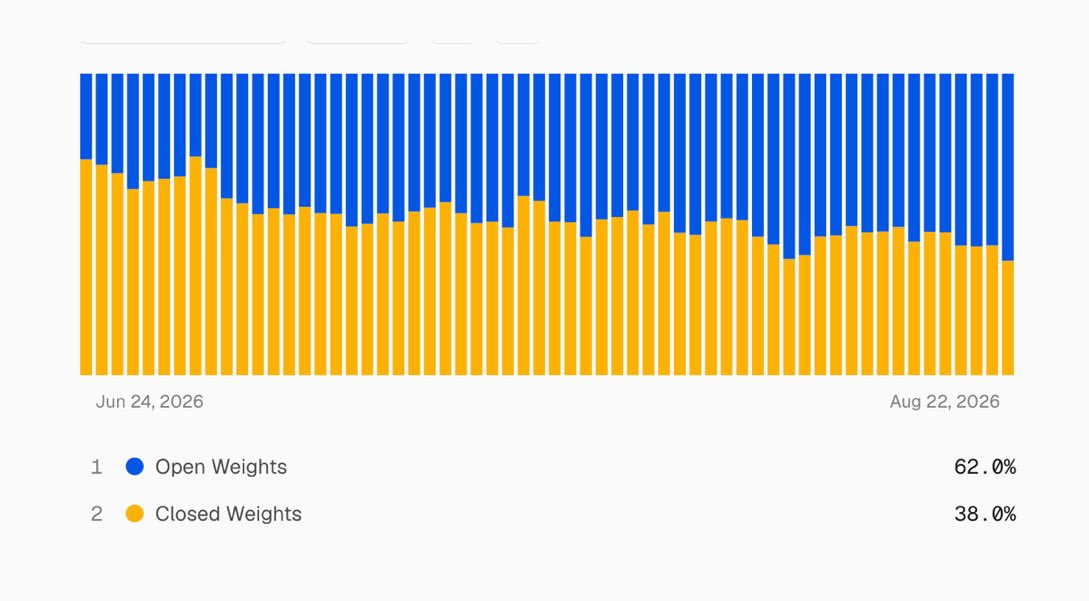
Daily token volume through Vercel’s AI Gateway, June 24 to August 22: open weights closing the final day at 62 percent. Source: Vercel’s live model leaderboard3.
Two purchases in one word
Intelligence, it turns out, is not a commodity we buy. It is two commodities we buy, and we have been using a single word for both. The first is a rare consultation: the hard question, the strategic fork, the contract clause that decides a quarter. For that, we want the best mind available and we want it now, and we should pay almost anything, because the right answer is worth almost anything and the wrong one is ruinous at any discount. By the same gateway’s July index, a single frontier provider gathered about 65 percent of the spending at roughly 4.4 times the average price per token; that is not a market being fooled, it is a market paying the specialist’s fee. The second purchase is a daily workforce: the ten thousand small classifications, summaries and lookups that a business runs on. For that, we do not want a genius on retainer. We want a reliable employee whose wages compound into something we keep.
A thing worth doing is worth doing badly, as the old paradox has it: most of life is not performed by specialists at the peak of the art, but by ordinary people doing ordinary work well enough. A household does not hire a Michelin chef to make its breakfast. Neither should a company summon the frontier to sort its invoices. The frontier premium is not a racket; it is the entirely rational price of a scarce, excellent thing at the moment we most need it. The mistake is to pay consultation prices for workforce labour, every day, forever, out of habit.
The equity nobody rents
The last time we sat with these matters, we noticed that almost every part of a company can now be rented by the job; the moat, it turned out, was mostly the paperwork. The more interesting question is the one a family firm asks by instinct: what should we refuse to merely rent? The market has begun answering with the oldest lesson in commerce, the difference between renting and owning. Thomson Reuters reportedly spent some 40 million dollars4 building its own model, named “Thomson,” on Alibaba’s open-weights Qwen. Its chief technology officer, Joel Hron, put it more plainly5 than any strategist could: “Renting a house, you still have a roof over your head, and somebody’s taking care of it, and it’s great. But you’re not building any equity that compounds into something valuable for you long term.” That is the whole doctrine in a sentence about real estate. Harvey, the legal AI firm, fine-tuned the open-weights Kimi K3 into a model it calls Tenet6, reaching the top of its own contracts benchmark at less than a quarter of frontier inference cost. Airbnb runs Qwen for customer service. Cursor built its Composer on Kimi. These are not thrift-store bargains; they are companies deciding that the work they do a million times a day is work they ought to own.
And the tools to own it now exist. Several open-weights models sit within a few points of the frontier on the widely watched intelligence indexes, and Qwen alone has spawned more than 151,000 derivative models7 on Hugging Face: a workshop the size of a nation, where the tools are free to take and ours to sharpen.
The invoice hidden in the cheap ticket
But there is an honest catch, and prudence demands we name it. Cheap tokens are not the same as cheap work. By one careful measurement8, Kimi K3 costs about half as much per token as the frontier’s GPT-5.6 Sol, yet finishes a comparable task for roughly 94 cents against a dollar and four, because it spends far more words getting there. Verbosity is an invoice that arrives later. The unit that matters is never the price per million tokens; it is the cost per completed task, the total bill for the thing actually done. And the frontier is not standing still to be undercut: one flagship’s output price fell by a third in a single August, another model’s by 80 percent in July. Which clarifies the real argument. The case for owning was never that renting is dear. Rents fall all the time. The case for owning is that rent, however low it goes, does not compound, and equity does.
What to decide this quarter
So the framework a leader can apply this quarter is mercifully simple, and it begins with a question about frequency and stakes rather than about models. For any given task, ask two things: how often do we do it, and how much does being wrong cost us. The rare, high-stakes judgment is a consultation. Rent the frontier for it, pay the premium without flinching, and measure the value in outcomes, not tokens. The frequent, bounded, patterned task is workforce. Own the workhorse: fine-tune an open-weights model on the one asset no competitor can rent, which is our own accumulated data, and measure it in cost per completed task. Most companies will find the line falls in a surprising place, with far more of the daily work belonging to the workshop than to the consulting room.
There is a national version of this same sentence being written a short drive from where many of us work. Canada has committed some two billion dollars to a sovereign compute strategy9, and the national plan announced this June10 with Mila in Montreal sets a course for hundreds of megawatts of homegrown capacity by 2030. A country, like a company, is deciding that some of its intelligence is too fundamental to merely rent. Only what we own learns for us, and only what learns for us becomes patrimoine, something we can hand on.
The first act of ownership is smaller than it sounds and larger than it looks: a single fine-tune on our own data, judged against our own benchmark, scored by our own evaluation set. It is the deposit on the house. The rent on the frontier will still come due, and we should pay it without resentment, because genius on demand is worth the fare. But we will be paying it, at last, as owners of something, and not only as tenants of everything.
Written by Herman Geldenhuys in Montreal.
Sources
- vercel.com, one large gateway’s count
- @GavinSBaker on X, touched a single-day record of 62 percent
- vercel.com, Vercel’s live model leaderboard
- the-decoder.com, some 40 million dollars
- thenextweb.com, Joel Hron, put it more plainly
- harvey.ai, a model it calls Tenet
- huggingface.co, more than 151,000 derivative models
- kylon.io, one careful measurement
- ised-isde.canada.ca, sovereign compute strategy
- cbc.ca, national plan announced this June
Keep reading
Standard Gauge
A company is sovereign in AI when it owns the seams between its work and the model: its data, its test of good work, its agents’ memory and the interface. This year showed what renting them costs, and the first seam takes one evening to reclaim.

Slow Down, Says the Car in Front
The frontier labs asked to be slowed down and their biggest rivals agreed within hours. Read what they agreed to: a slowdown capped at the size of their lead, and a lead defended by rule.

Name the Hour
Three quarters of Quebec firms cannot say which problem AI would solve for them, and Statistics Canada finds that adopting AI on its own does nothing measurable. Both facts point the same way: the first step is not a tool. It is a sentence.