WritingEssay
Standard Gauge
A company is sovereign in AI when it owns the seams between its work and the model: its data, its test of good work, its agents’ memory and the interface. This year showed what renting them costs, and the first seam takes one evening to reclaim.
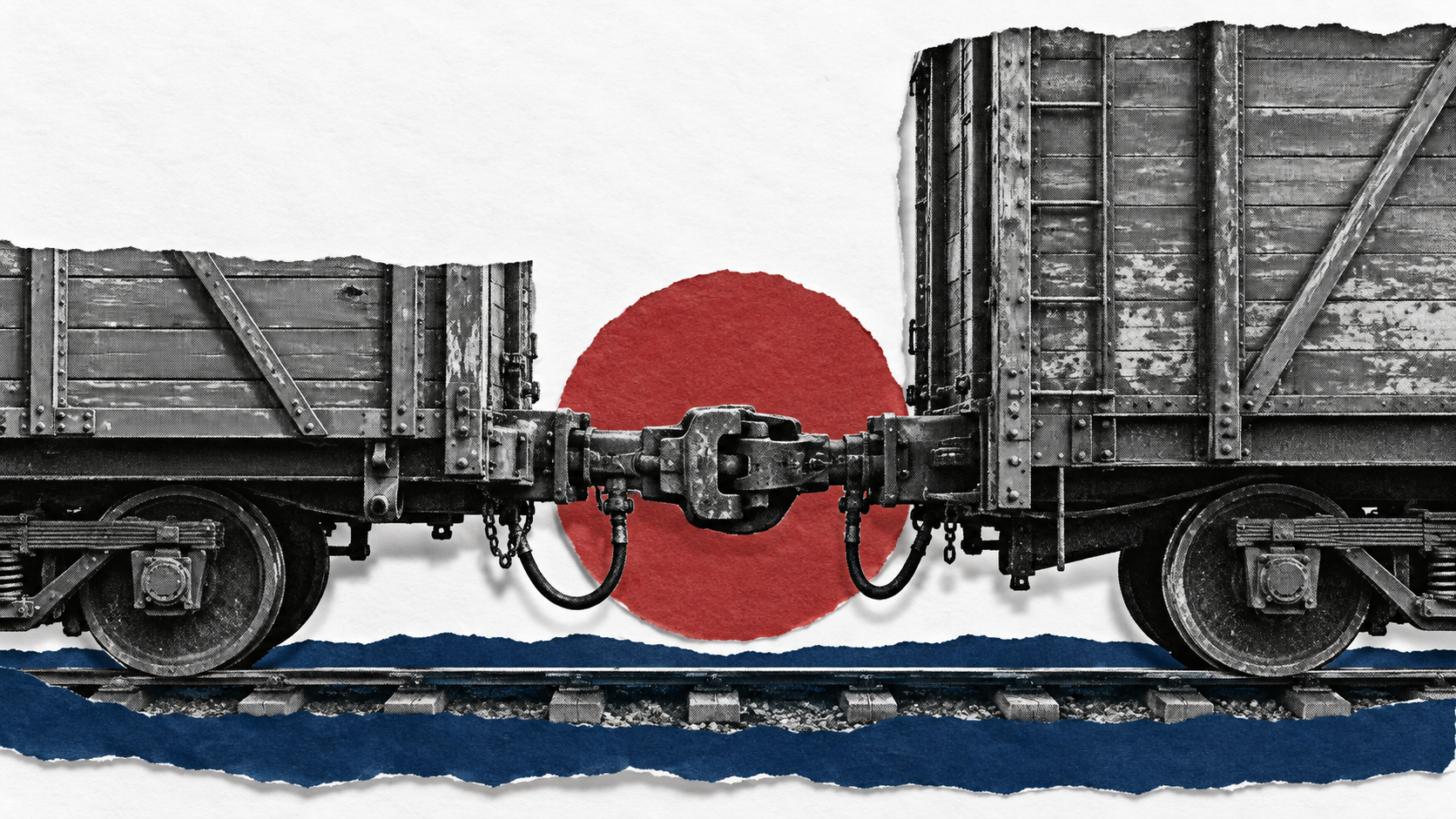
In AI, a company is sovereign when it owns the seams. There are four of them: our data, our own test of what good work looks like, the memory our agents build up, and the thin interface between our work and whichever model does it. Own those and every model becomes a supplier. Rent them and even the servers in our own basement belong to someone else. The cheering part is how small the seams are. A builder can start on one tonight, with an editor and a pot of coffee.
A freight train makes this plain. The model is the locomotive at the front. It gets the photographs and the headlines, and it is the part we rent. Everything behind it is ours: the cars, the cargo, the logbook, and the coupling that joins them to the engine. A railway that owns its couplings, and lays its track to a standard gauge, can hitch whatever engine pulls into the station. A railway that welded its cars to one engine has bought itself a very long engine.
The year the engines stopped
On 12 June, a US Commerce Department directive made Anthropic cut off every customer from its top models1. Its statement was blunt: “we must abruptly disable Fable 5 and Mythos 5 for all our customers.” The controls were lifted on 30 June. Michael Geist drew the lesson in the Globe and Mail: “the U.S. can switch AI access on and off at its discretion.” Where the model’s name lived in one configuration file, those weeks were an inconvenience. Where it was scattered through the code like confetti after a wedding, they were weeks of sweeping.
The memory seam moved in August. OpenAI retired its Assistants API after a year’s notice, and its migration guide2 put the matter in one sentence: “The Assistants API call that retrieves thread messages no longer works; use your stored messages instead.” Excellent advice, and perfect for anyone who had already taken it. Customers who kept their own copy of every conversation kept their history. Everyone else learned where their agents’ memory had been living.
Our data has its own fine print, and the fine print travels. Since 17 August, Atlassian trains its AI on customer metadata by default3, and it told The Register that below the Enterprise plan “metadata contribution is always on, and they are not able to opt out.” Every rack stayed exactly where it was, and the seam shifted anyway.
This is why hauling hardware home only goes part of the way. In a Cloudera survey of 1,500 architects4, two thirds said they had moved AI workloads off the public cloud in the past year, a figure we read with one eyebrow raised, since Cloudera sells hybrid platforms. After an ALL IN panel on the build-or-buy decision this month, the board director Muriel McGrath wrote5 that sovereignty “isn’t just about where your data lives.” She put the weight on “your autonomy and your ability to future-proof your company as AI moves quickly.”
A server in our own building, running an agent whose memory sits in a vendor’s thread store, is a goods yard we own with someone else’s padlock on the gate. Possession, we are told, is nine points of the law. In AI the hardware is the tenth point, and a modest one.
Geist adds a line that keeps us honest: “relying solely on open models is not an option for many organizations”. Good. Nobody is asking us to build our own locomotive. We only need to own the couplings, so the best engine of the season pulls our train today and a different one can pull it tomorrow.
Rent in perpetuity
Quebec learned this lesson about land long before any of us met a language model. The seigneurial system was abolished in 1854, yet the seigneurial rents were “payable in perpetuity”6. In 1928 nearly 60,000 families were still paying them, and the municipalities made the last payment in 1970. Abolition ended the system and left the rent standing. The rent stopped when the capital was bought out.
A sovereignty strategy announced in a slide deck works the same way. We can abolish our dependence on a Tuesday and keep paying rent on it for years, in migrations and in contract terms we signed to avoid a rewrite. The rent stops when the capital sits in tables we control. Designing that in on day one costs a fraction of buying it back later, as those families could have told us.
Going AI-native means pulling out a great deal of old machinery, fast, and most of it has earned its retirement. A fence in a field, though, is a question somebody answered before we arrived. Some old fences are sovereignty lines, like the rule about where customer records may live. Others look like clutter: an audit log nobody reads, or a nightly job that writes a dull file to storage we own. That dull file may be the most sovereign thing in the building. Before we pull a fence out, we find out who put it there and why.
One engine change
The first experiment fits in an evening. We pick one live workflow, the smallest one that matters, and gather real cases from last month, writing beside each the answer we would accept. That folder is our evaluation set, the only thing we own that knows what good means here, and it is worth more than any model we will ever rent. We put the model behind one function that reads the model’s name from configuration. That function is our standard gauge; any engine built to fit it can run on our line. We store every exchange in our own database, in plain rows a person can read. Then we run the cases against today’s model and against a second one.
Something changes in the room when a second engine pulls the same train. Close or far, the scores turn the price of leaving into a number, and a number is much easier to live with than a vague unease.
Owning the seams has a happier consequence, the one an AI-native organization should care about most: it makes us fast. The same Cloudera survey found that 95% of those architects had delayed or cancelled AI projects over governance. When the seams are ours, the governance questions have answers before the meeting starts, and the pilot ships this month instead of next quarter.
The quarter needs owners. Our CIO can walk each AI workflow seam by seam and write down who could export each one tomorrow morning; some answers will say nobody, which is where every honest map begins. Procurement has the pleasanter task of writing an exit right into the next AI contract, with a full export in an open format and notice before a model is retired. Suppliers who intend to treat us well will sign it without a fuss, and the ones who fuss have told us something useful. The right to leave is what turns staying into a choice. Our technical lead then runs the evening experiment again, this time on a workflow people depend on, once and for real.
Somewhere in our code, a model’s name is typed straight into a function that never needed to know it. Tonight we go and find it.
Written by Herman Geldenhuys in Montreal.
Sources
- aljazeera.com, cut off every customer from its top models
- developers.openai.com, migration guide
- theregister.com, trains its AI on customer metadata by default
- virtualizationreview.com, Cloudera survey of 1,500 architects
- LinkedIn, wrote
- thecanadianencyclopedia.ca, “payable in perpetuity”
Keep reading

Slow Down, Says the Car in Front
The frontier labs asked to be slowed down and their biggest rivals agreed within hours. Read what they agreed to: a slowdown capped at the size of their lead, and a lead defended by rule.
Name the Hour
Three quarters of Quebec firms cannot say which problem AI would solve for them, and Statistics Canada finds that adopting AI on its own does nothing measurable. Both facts point the same way: the first step is not a tool. It is a sentence.
Rent the Frontier, Own the Workhorse
The strangest chart in AI shows usage flooding toward cheap open models while the money concentrates at the frontier. It is not a paradox: intelligence is two purchases wearing one name, and only one of them compounds.